Creative Leadership Philosophy
WSJ Creative Leaders, 3-Column Justified
FOX’EM FOX
Robert Fox continues to focus on helping leadership teams navigate convergence through strategic ecosystem thinking, market credibility acceleration, and future-oriented positioning across AI, mobile, and emerging technology landscapes. The following is what keeps his juices flowing…
KISS from the Start
Great ideas are often the least complex. Keeping it simple, stupid, is never more important than in the clarity and directness of communication.
My belief has always been that first thoughts are often the best thoughts. But you cannot be precious with them. Don’t suppress those raw impulses—throw them into the fire. Run them through the fireworks department. The concepts that survive the immolation are almost always your winners.
None of this means screwups can be entirely avoided. Perfection is an illusion. Always be ready to admit your mistakes quickly; if you don’t, you aren’t learning a thing. Outfoxing the market isn’t about being infallible. It’s about being agile, direct, and brave enough to test your sparks.
Mad Men Fundamentals
I grew up as an account executive trainee in one of London’s top two marketing agencies: Masius, Wynne-Williams on St. James’s Square. The other was J. Walter Thompson on Berkeley Square. Both enjoyed a significant degree of custom from nearby haberdashers, tobacconists, high-end restaurants, and a couple of well-attended pubs which served as our off-site offices.
Alcohol was the expected lubricant for creative inspiration and lengthy client meetings. I gained immense respect for the few women who made it to the top in what was a testosterone-driven world of over-indulgence.
Despite the distractions, I finally managed to engage with true learning. Having applied myself entirely to social rather than academic pursuits while up at Oxford, pushing me into advertising was my father’s last-ditch attempt at having me settle down. I didn’t settle down so much as settle in.
The agency floor taught me that craft is communal. Typesetters, retouchers, and account men argued at the same long tables, and the better the argument, the better the work. The friction between disciplines is where the spark lives—and a creative leader’s job is to keep that friction productive rather than personal.
What follows is less a CV than a set of working beliefs: about simplicity, about language as territory, about the patience required to keep an idea alive long enough for the market to recognize it.
My internship took the form of a comprehensive, all-department apprenticeship—an unbelievably costly investment in recruits that could never be afforded today. Over several months, I became fascinated by the intricacy of overnight packaging, font selection, and cold typesetting. I breathed in the fumes of photography and learned the distinct scent of different finishes, papers, and glues.

Media planning and buying were made immersive by publishers’ parties; casting became one with copywriting; and the heady world of art direction became my Olympus.
My first strategic success resulted from the friction of this layout. The traditional order of things saw buttoned-up, three-piece-tailored account executives meet with clients, then return to brief the much more informal creative teams.
With the advantage of a training oversight that bridged all departments, I saw how much became lost in translation. Account executives didn’t speak creative, and creatives didn’t speak business. It may have helped billable hours, but it took forever for clients to be truly satisfied. Because I spoke both languages, I pitched both sides in true referee style and became the agency’s first Creative Coordinator.
From then until today, that fundamental truth has guided me: you must bridge the gap between concept and execution. I have always sought to innovate both internally and externally, exploring old adages and creating new ones.
We must recognize that word of mouth delivers with a two-edged tongue, and remember the old thrift of waste not, want not. In a noisy world, optimal focus means convincing ten percent of the people one hundred percent of the way. To do that, you must write images and visualize words, realizing the immense power hidden in generic terms.
Above all, we must be prepared for the shifting tides of communication. Today, stakeholders have become influencers. It is all in a word. If you do not employ a purposeful nomenclature—deploying terms like CatalystXcelerator or Difference Paths to define your own ground—the market will gladly define it for you.
Staying on Track
Sisyphus said it best: “Once we get this rolling in the right direction, there’s no limit to where momentum will take us.” An avid surfer, he also understood the importance of looking ahead and changing waves before momentum fades.
To find direction, however, you must first understand the topography of confusion. My own family’s heritage includes Glendurgan Garden in Cornwall, home to a historic, winding hedge maze. Throughout my career, that maze became a living metaphor—recalled vividly whenever I found myself inside the labyrinthine communication structures that large organizations tend to build around themselves.
I have also spent more time than I should admit trying, with myopic intensity, to untangle modern news cycles in search of a shred of unvarnished truth. You cannot find the center of any maze by following the crowd, nor can you discover truth by looking where everyone else is looking.

Much of modern industry still works through predictable cycles of repetition: new terminology wrapped around familiar thinking. Real transformation rarely comes from following momentum alone. It comes from recognizing emerging convergence early, identifying alternative “difference paths,” and aligning the right ecosystems, technologies, and influencers before markets become crowded by imitation.
Where there have always been trailblazers, we increasingly need seers. We need conceptual and mathematical thinking working together. Human intelligence and AI reasoning evolving in parallel. Strategic imagination applied simultaneously to both our physical and artificial worlds, whose futures are now irrevocably intertwined.
Our environment increasingly resembles a particle accelerator of intersecting systems: AI, connectivity, mobility, infrastructure, media, behavioral economics, and ecosystem influence all colliding at extraordinary speed.
Many organizations unintentionally narrow innovation potential by equating youth with adaptive thinking, despite the reality that pattern recognition, strategic foresight, and systems-level insight often deepen through experience.
I believe the future belongs to organizations capable of balancing innovation with clarity, acceleration with direction, data with imagination, and ecosystem scale with human relevance.
The Wall Street Journal
Challenges inspire. Changing perceptions of the WSJ from a stodgy business forum to a primary creative platform through Jim Johnston’s Creative Leaders campaign is legendary.
Fortunately for me, Jim prided himself on hiring youthful talent with doctoral-level backgrounds as an indication of ability to learn. Despite never completing a thesis, I somehow fit the bill and ended up as a very young Executive VP of Special Accounts—which really meant he had no finite role for me except occasional, disruptive support.
I traveled to WSJ events with Jim and listened as he debated with Dow Jones marketing, sales, and publishing leadership. Aside from being an Anglophile, Jim loved annotating and employing Bartlett’s Familiar Quotations. An idle comment from me—“If I can’t remember what I thought, it’s not worth mentioning”—qualified as one of his added entries. From then forward, he looked for my opinion and creative input on multiple campaigns.
“All the cream. All the time” was my solution for a WSJ ad where our production department had trouble rendering a top-of-the-milk visual in black and white.
“It Works” was a tagline I arrived at after we had labored for months to find a fitting sign-off. (I don’t really like taglines any more than I like logos in boxes; they tend to confine.) Fortunately, however it was applied, “It Works” worked and is still in use decades later. If anyone instilled in me the importance of working through to distinction that made an on-brand difference, it was Jim.
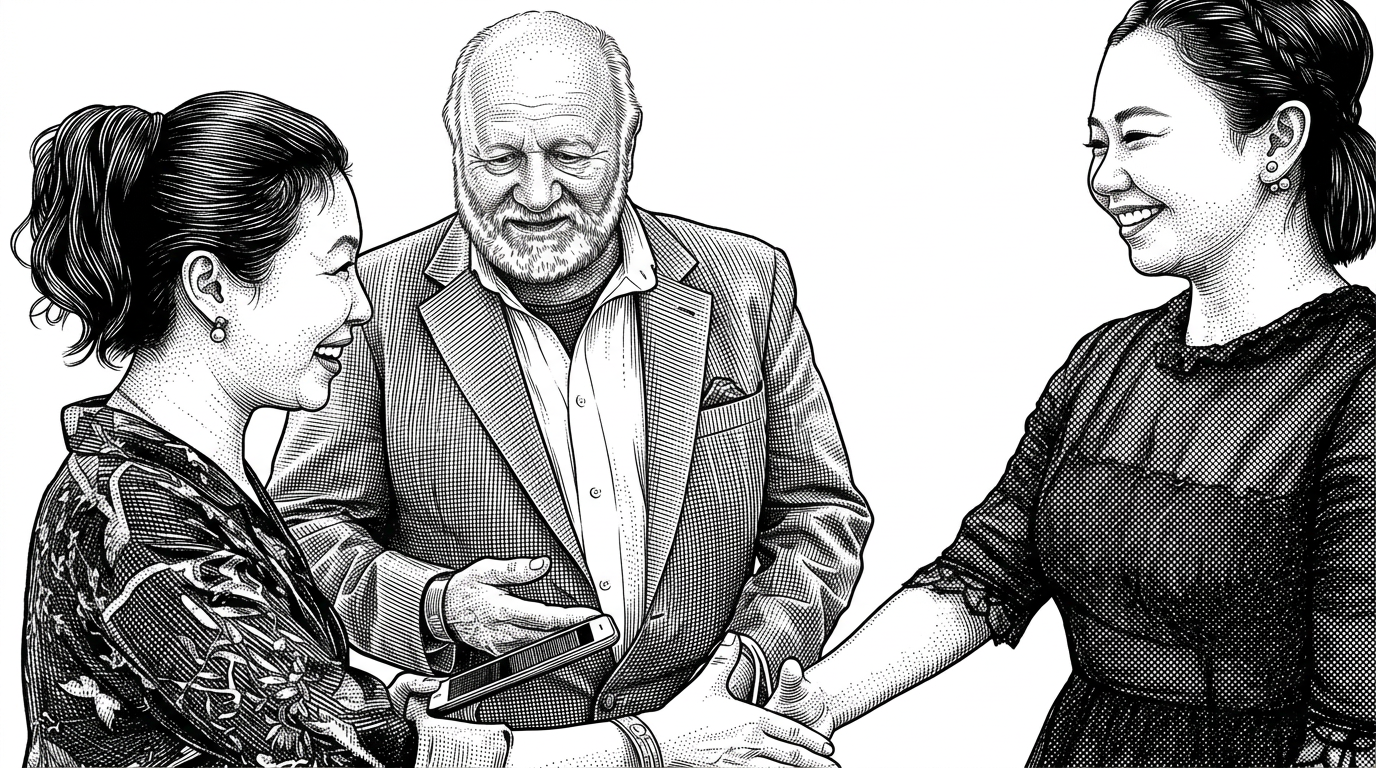
That pursuit of distinction eventually required moving beyond single campaigns and into the orchestration of global third-party relations. In a hyper-connected economy, a creative strategist must act as the ultimate facilitator—bringing diverse ecosystems, international stakeholders, and brilliant minds together to shake hands on a shared vision.
Acknowledgements
With gratitude to Jim Johnston and the Dow Jones / Wall Street Journal marketing, sales, and publishing teams who first invited me into the Creative Leaders conversation, and to the agencies, clients, and collaborators across London, Frankfurt, and New York whose friction and generosity shaped these working beliefs.
Inspiration
The format and spirit of this piece pay homage to the WSJ Creative Leaders series—Jim Johnston’s long-running campaign of long-copy executive portraits, archived and studied at universities from Columbia to Wharton.
Norman Berry’s “Norman Conquest” ad provided the specific layout reference: a single large hedcut portrait flush-right, three columns of justified type wrapping above and to the left.
Image Credits
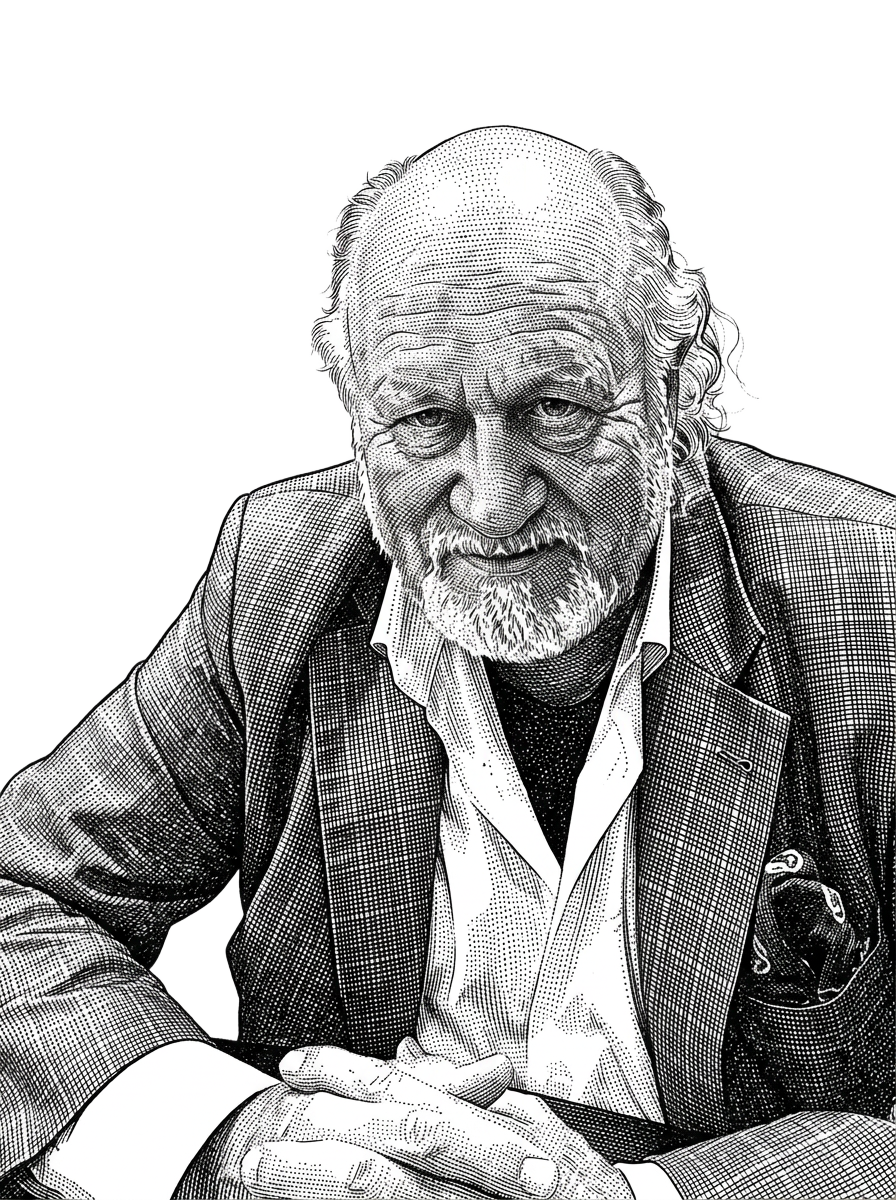
Portrait hedcut — stylised in the manner of the WSJ’s signature stipple engravings. Photo source © Bo Zaunders Photography, NYC.
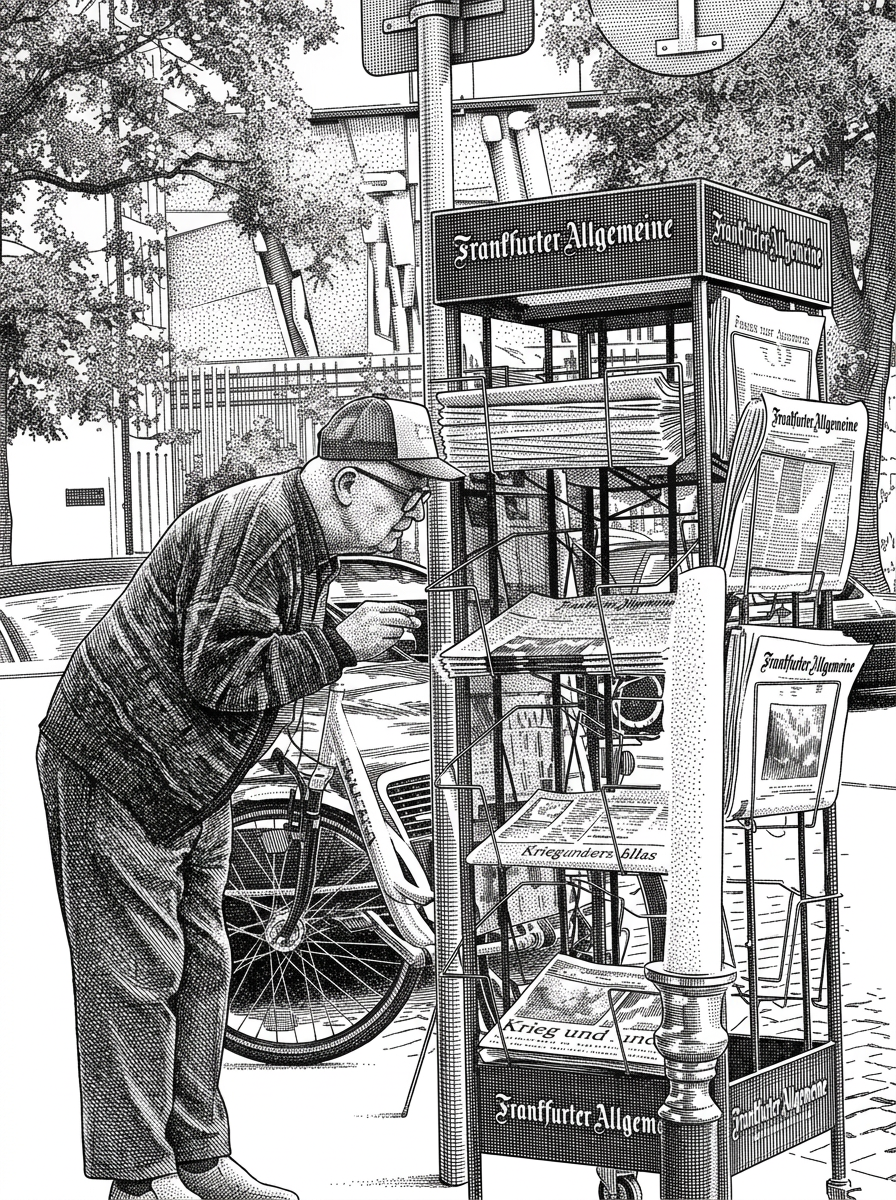
Vignettes (crosshatch engravings): Glendurgan garden maze, Cornwall; Frankfurt newsstand; divided pedestrian and bicycle lane sign, SXSW Austin Texas, 2014; global handshake. © Robert Fox.
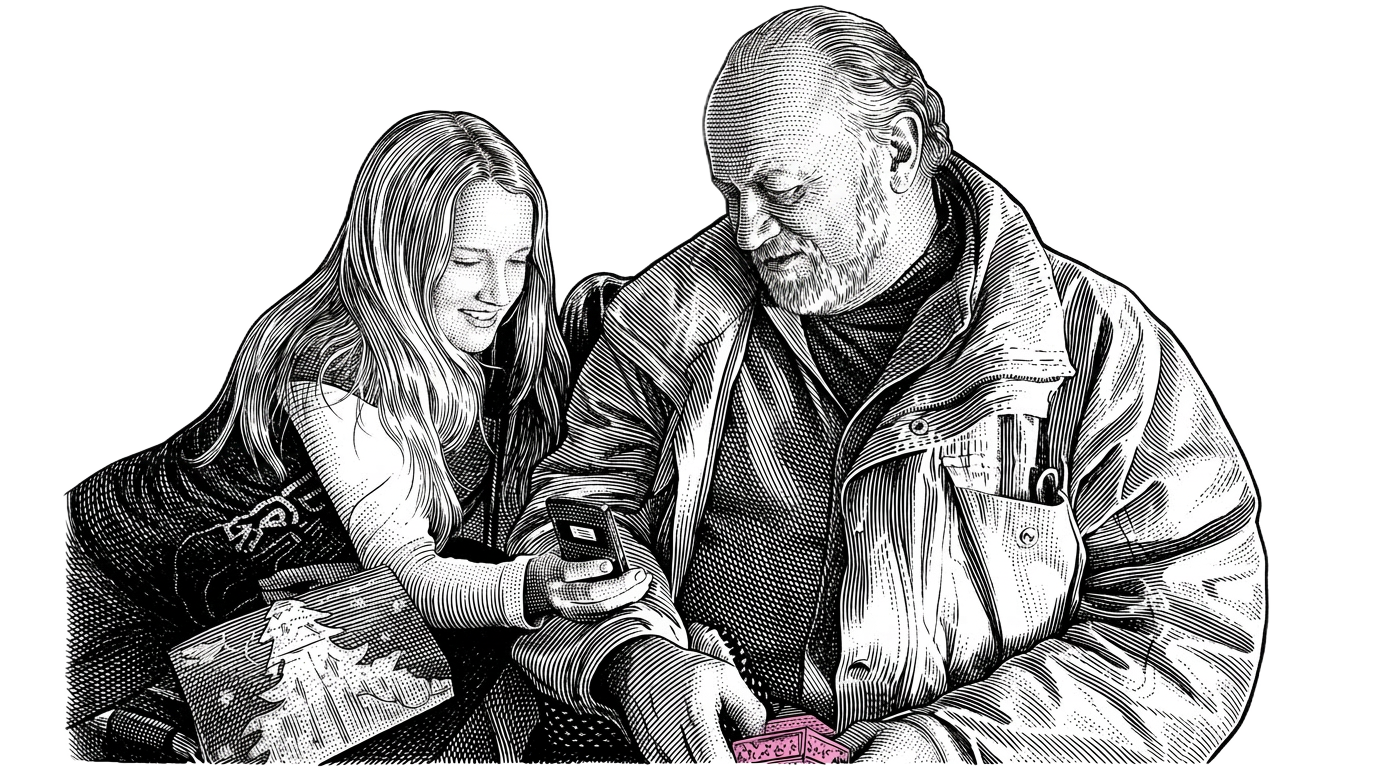
Father to daughter — passing the torch. © Bo Zaunders Photography, NYC.
Further Reading
Bartlett’s Familiar Quotations—the volume Jim Johnston kept close at hand and occasionally annotated. Available as an ebook for $27.99 from Barnes & Noble.
David Ogilvy, Confessions of an Advertising Man.
Dave Dye, “The Wall Street Journal’s Creative Leaders Series,” davedye.com, 6 June 2019.
Colophon
Set in a serif text face with sans-serif metadata, in the broadsheet manner. Three-column justified body, double-rule masthead, and 8½×11″ page geometry to echo the original newspaper-page Creative Leaders ads.
© Robert Fox. All rights reserved.