A potted history of the Global Mobile Broadband Forum from its proposal in 2009 through to the 2018 London edition, the period during which the event was shaped, named and convened from within Huawei Wireless. Corporate Huawei staged its own variants of the format from around 2014, but nothing of comparable significance from those corporate-led editions emerged until the early 2020s.
Strategic intent
Conceiving and establishing the Global MBB Forum was a deliberately disruptive, creatively aggressive strategy to gain overnight Western credibility, to assert leadership through the words and presence of others, and to lay the groundwork for accelerated sales and focused regional R&D. Read in sequence, the net results of each edition are all of historical importance.
2009, Proposal
A new kind of industry gathering.
Huawei had traditionally hosted multiple single-technology events to address narrow opportunities. The annual GMBBF was proposed as a unifying forum designed to attract and impress operational leadership, evidence pioneering cross-industry LTE commercialisation, introduce automated network management and outline the initial concepts through which Huawei would lead the way to 5G.
01C-level global invitees
02Minimal Huawei presentations
03Inter-audience participation
04Operators speaking candidly of operational and market challenges, and of their work with Huawei, alongside analysts and industry bodies
05Third-Party Relations campaign to include headliner presenter and exhibitor participation at each GMBBF
Editions, 2010 to 2018
2010
Oslo, Norway
01
Inaugural forum, marking the dawn of commercial 4G LTE and the operator transition from voice-heavy 3G to data-first mobile grids.
World's first LTE network validation
Co-hosted with TeliaSonera, presenting the operational results of the world's first commercial LTE network and proving to global operators that LTE was commercially viable and ready to scale.
SingleRAN strategy initiative
Foundational SingleRAN roadmap laid down, convincing early adopters that a single software-defined base station could consolidate CDMA, GSM and UMTS into a unified footprint and cut operator capex.
Headline participation
Presentations by Facebook and the GSMA CTO established the look and feel of the new event, drove media and word-of-mouth coverage, and validated advance interest in subsequent editions.
Scheduled for Oslo, moved to Sandvika after attendee and participant response exceeded 100% of original capacity. The format set a new, more informal tone, favouring candid conversation over one-way presentation.
2011
Berlin, Germany
02
Centred on the 'Data Tsunami', the sudden, massive explosion of mobile data consumption driven by the first wave of smartphones.
SingleRAN commercial rollout
SingleRAN advanced from concept to commercial reality, letting operators support 2G, 3G and 4G LTE simultaneously on a single unified base station rather than parallel networks.
The mobile cloud era
Major investment announced in infrastructure bridging mobile broadband with cloud computing, shifting application processing from device to network.
Third-party programme expanded
Third-party speakers broadened to include YouTube, with senior industry-body presence firmly established. Worked with the GSMA, ETSI and Current Analysis to initiate an EU MBB tracking project.
2012
Vancouver, Canada
03
Huawei's first major technology forum hosted in North America, focused on the economics of scaling 4G LTE across vast geographies.
Multimode and multi-band LTE
New antenna technologies unveiled to aggregate mismatched spectrum bands (Carrier Aggregation), letting operators maximise data speeds without acquiring expensive new spectrum.
No-Edge Networks
The 'No-Edge Network' concept introduced, using advanced inter-cell coordination to eliminate weak-signal zones at coverage boundaries and provide uniform speeds to moving users.
CTO Roundtable introduced
Introduced the CTO Roundtable as an arrival-afternoon precursor to the main programme, a format that became a constant fixture of every subsequent forum.
2013
London, United Kingdom
04
Co-hosted with the GSMA and GTI, the focus shifted from raw infrastructure capacity to network automation and user experience.
SoftCOM strategy
Practical rollout of SoftCOM detailed, integrating SDN and NFV into a roadmap for fully programmable, cloud-based networks capable of automated scaling.
VoLTE acceleration
Huawei and major European operators announced successful field trials and commercial deployment strategies for Voice over LTE, framing the phase-out of 2G and 3G voice circuits.
2014
Shanghai, China
05
Held during the wave of major 4G deployments in Asia, the fifth annual forum marked the birth of early 5G frameworks and the cellular Internet of Things.
4.5G technology concept
4.5G (LTE-Advanced Pro) formally defined and introduced to the global industry, with sub-10ms latency and up to 100,000 devices per square kilometre achievable on existing evolutions ahead of true 5G.
Cellular IoT and NB-IoT origins
Breakthroughs announced in machine-to-machine hardware, pushing global standardisation of what would become Narrowband IoT, the low-power connectivity layer for smart cities and wearables.
2015
Hong Kong
06
Hosted alongside HKT and 3 Hong Kong, the forum officially launched the 4.5G era with the world's first live 1Gbps mobile network.
World's first 1Gbps live mobile network
Live demonstration peaked at 1.2Gbps, proving that existing 4G LTE architectures could be evolved using carrier aggregation and 4x4 MIMO multi-antenna technology rather than waiting for new spectrum.
MBB 2020 strategy
Industry leaders mapped out the MBB 2020 strategy, shifting focus toward early Narrowband IoT standardisation and the mass data demands of early virtual reality.
2016
Tokyo, Japan
07
Centred on expanding the mobile ecosystem through cross-industry partnerships with 20+ global operators and 10+ vertical industry partners.
Vertical industry summits
Co-hosted with the GSMA, the event featured dedicated summits on Mobile IoT, Cloud Transformation and initial 5G New Radio architecture, broadening the audience well beyond traditional carriers.
CloudRAN 5G and LTE Dual Connectivity
Huawei debuted a live CloudRAN-based 5G and LTE Dual Connectivity demo hitting 21Gbps peak throughput, showing that carriers could deploy early 5G services directly over existing 4G networks.
2017
London, United Kingdom
08
Record 1,400 industry leaders. The convergence of physical and virtual worlds moved from theory to live demonstration.
World's first live 5G sports broadcast
BT Sport beamed a live 5G broadcast direct from Wembley Stadium, a public proof point that 5G could carry premium media workloads at scale.
5G City debate
Heavy industry debate on the '5G City' framework with executives from Orange, Telefonica and Telus, framing how municipal infrastructure would underwrite carrier 5G economics.
Enterprise incubation
Carriers urged to aggressively incubate enterprise applications, famously illustrated by Huawei's 'Connected Cows' use-case, to prepare business models ahead of 5G core network migration.
2018
London, United Kingdom
09
Co-organised with the GSMA and GTI. 2,200+ delegates under the theme '5G Inspiring the Future'. The staging ground for global 5G commercial rollout.
From lab to live deployment
Strategic discussion shifted from laboratory testing to real-world deployment challenges, site architecture optimisation, total cost of ownership reduction and provisioning for resource-heavy services.
Heavyweight 5G workloads
Cloud VR/AR, autonomous driving and industrial automation moved to the centre of the agenda as the headline workloads justifying 5G capex.
Corporate Huawei had begun staging its own variants of the format from around 2014, but the GMBBF as conceived and run from within Huawei Wireless remained the industry-defining event through this period. Nothing of comparable significance from the corporate-led variants emerged until the early 2020s.
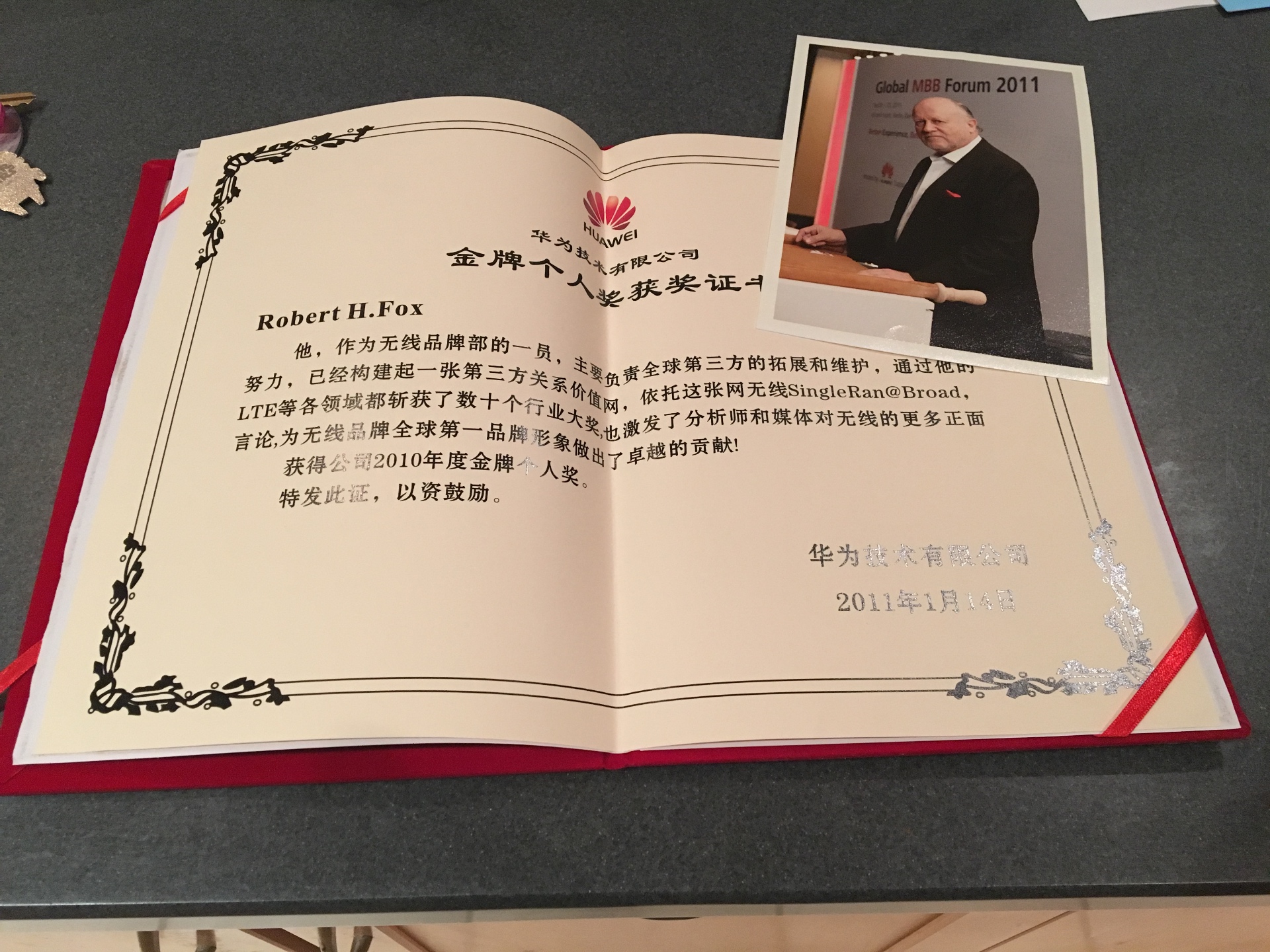
Huawei's internal Gold Individual Award, conferred in January 2011, cited the build-out of the third-party relationship value network and its role in driving dozens of industry awards across SingleRAN, LTE and the wider wireless portfolio, alongside the shift in analyst and media sentiment that helped establish Huawei Wireless among the top-tier global wireless brands.
The citation reflects the work the Global MBB Forum was conceived to do: convert convening power into category authority, and category authority into commercial and ecosystem position.
In summary
Across nine editions the forum moved from validating LTE in Oslo, to defining 4.5G and the origins of cellular IoT in Shanghai, to staging the world's first live 5G sports broadcast from Wembley and framing the global 5G commercial rollout from London. The convening architecture, the third-party programme and the CTO Roundtable format built across this period gave Huawei Wireless its industry voice and locked in the technical roadmaps and spectrum strategies that underpin the high-bandwidth 5G networks deployed globally today.